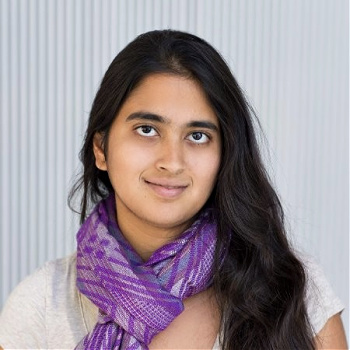
Jaya Narain
Sr. Research Scientist, Apple Health AI
I am a Senior Research Scientist at Apple Health AI, where I work on applied machine learning with multimodal data, with deep expertise in sensor and speech modeling and affective computing. I was a technical leader for the motion foundation model in Air Pods Pro 3 and also worked on developing and deploying personalized speech models for users with atypical speech for the Adaptive Voice Shortcuts feature. My research includes characterizing speaking style like naturalness and tone and fairness implications for users with atypical speech, domain-driven methods for learning from motion data, and understanding the mechanics of LLM instruction-following.
I received my PhD from the MIT Media Lab in the Fluid Interfaces Group, where I studied nonverbal communication in people who don't use typical speech. I was an Apple PhD Scholar in AI for Health & Wellness and an NSF Graduate Research Fellow. I co-founded the MIT Assistive Technology Hackathon (ATHack) in 2013 and led it for eight years, bringing together over 500 engineers, designers, and community co-designers to build assistive technology collaboratively.
My technical foundation spans signal processing, large-scale model training, dataset creation, and model evaluation across both research and product settings. I hold an MS and BS in Mechanical Engineering from MIT, which complements my expertise in human-centered machine learning with a deep understanding of physics and system design.
Selected Publications
-
2025RelCon: Relative Contrastive Learning for a Motion Foundation Model for Wearable Data (link)ICLR
-
2025Voice Quality Dimensions as Interpretable Primitives for Speaking Style for Atypical Speech and Affect (link)Interspeech
-
2025Affect Models Have Weak Generalizability to Atypical Speech (link)Interspeech
-
2025Speech Foundation Models Generalize to Time Series Tasks from Wearable Sensor Data (link)Workshop on Learning from Time Series for Health, NeurIPS
-
2025Do LLMs 'know' internally when they follow instructions? (link)ICLR
-
2025Do LLMs Estimate Uncertainty Well in Instruction-Following? (link)ICLR
-
2025Using LLMs for Late Multimodal Sensor Fusion for Activity Recognition (link)Workshop on Learning from Time Series for Health, NeurIPS
-
2025Switchboard Affect: Emotion Perception Labels from Conversational Speech (link)ACII
-
2024Leveraging Periodicity for Robustness with Multi-modal Mood Pattern Models (link)Workshop on Time Series in the Age of Large Models, NeurIPS — *equal contribution
-
2023Latent Phrase Matching for Dysarthric Speech (link)Interspeech
-
2023From User Perceptions to Technical Improvement: Enabling People Who Stutter to Better Use Speech Recognition (link)CHI
-
2023ReCANVo: A Database of Real-World Communicative and Affective Nonverbal Vocalizations (link)Nature Scientific Data — *equal contribution
-
2022Modeling Real-World Affective and Communicative Nonverbal Vocalizations From Minimally Speaking Individuals (link)IEEE Transactions on Affective Computing
-
2020ATHack: Co-Design and Education in Assistive Technology Development (link)Extended Abstracts, CHI
-
2020Promoting Wellbeing with Sunny, a Chatbot that Facilitates Positive Messages within Social Groups (link)Extended Abstracts, CHI — *equal contribution
Invited Talks
-
Invited Speaker. 'Data Efficient Learning and Generalization with Sensors and Speech'
-
Invited Speaker. 'ATHack, A Design and Educational Exercise in Accessibility'
-
Envisioning the Future of Technology for Mobility: A Panel Discussion
-
Assistive Technology for Opening Minds, Hands, & Hearts
Patents
-
Systems and Methods for Designing and Modeling Pressure Compensating Drip Emitters, and Improved Devices in View of the Same
-
Channel-Less Drip Irrigation Emitters and Methods of Using the Same
-
Device Sandwich Structured Composite Housing